What Benefits Might the Railroad Tracks Give to the British Fourth Army
On This Page - Jump to a Department Navigation
A Winter Encampment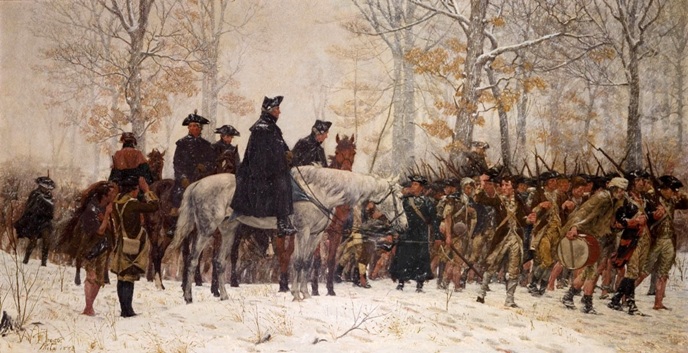
Valley Forge is the location of the 1777-1778 winter encampment of the Continental Army under General George Washington. Here the Continental Army, a collection of disparate colonial militias supported past hundreds of camp followers and allies, emerged nether Washington'due south leadership as a cohesive and disciplined fighting forcefulness.
In belatedly 1777 while the British occupied the patriot capital of Philadelphia, Washington decided to have his troops winter at Valley Forge, just a 24-hour interval's march from the urban center. Valley Forge was a naturally defensible plateau where they could railroad train and recoup from the twelvemonth's battles while winter atmospheric condition, impassable roads, and scant supplies stopped the fighting.
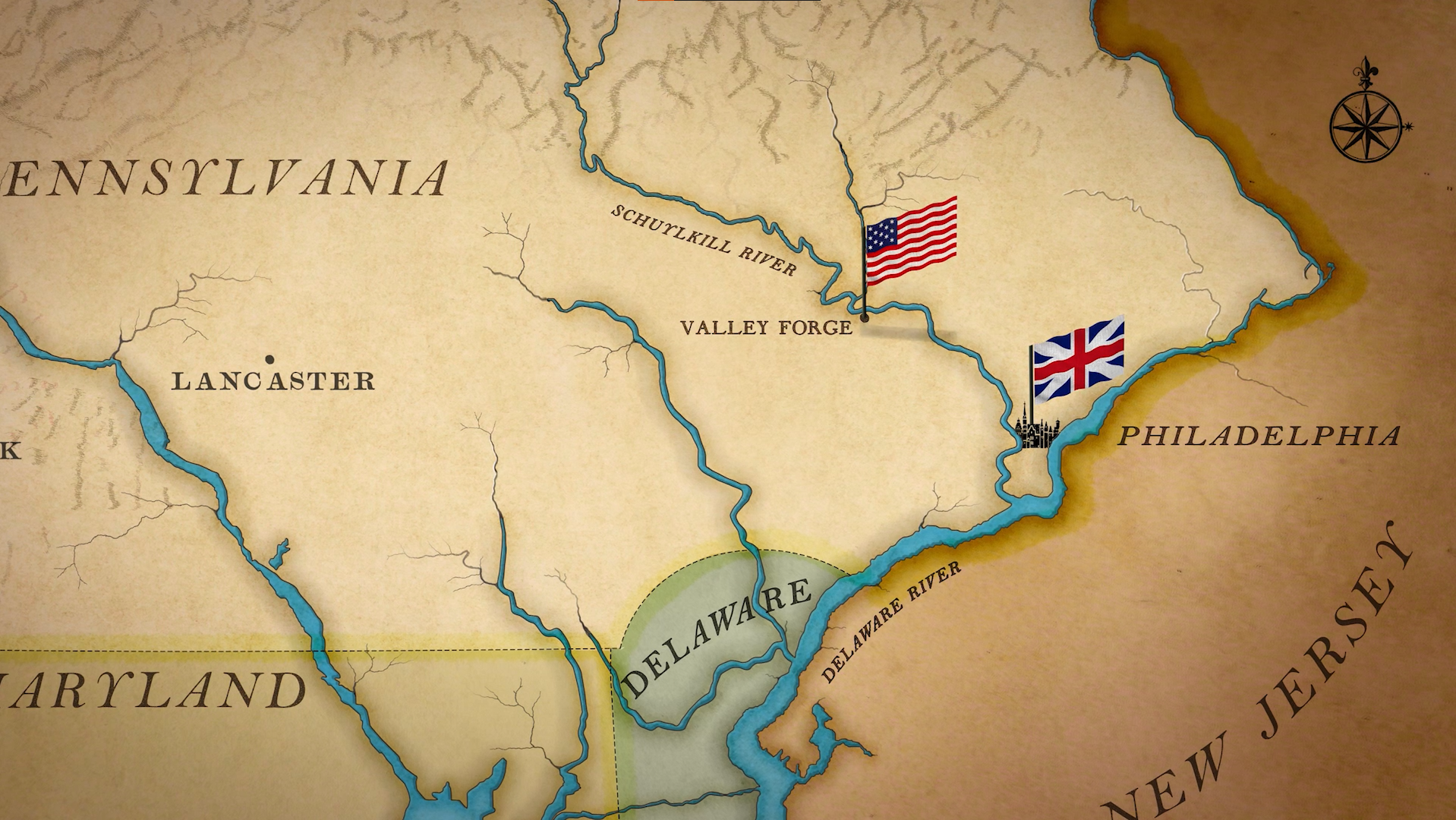
With the British occupying Philadelphia, Washington decides to encamp at Valley Forge for the winter.
Inflow at Valley Forge
Washington and his entrada-weary men marched into campsite on December xix, 1777. Contrary to popular myth, the Continental soldiers marching in to Valley Forge, while not well-supplied, were non downtrodden — just exhausted. They exuded the confidence of men who knew that they had come close to chirapsia the British in battle. They were charily optimistic nearly the time to come and resigned themselves to the task of establishing their wintertime camp.
The romantic epitome that depicts the troops at Valley Forge every bit helpless and famished individuals at the mercy of wintertime'southward fury and clothed in nothing just rags renders them and their commander a disservice. It would be hard to imagine a scenario in which the leader of a popular revolution stood by while his men froze and starved. The winter of 1777-78 was not the coldest nor the worst winter experienced during the war, but regular freezing and thawing, plus intermittent snowfall and rain, coupled with shortages of provisions, habiliment, and shoes, made living conditions extremely difficult. Rather than wait for deliverance, the army procured supplies, built log cabins to stay in, constructed makeshift clothing and gear, and cooked subsistence meals of their own batter.
Provisions were bachelor during the early months of the encampment. For case, regular army records of the food shipped to camp in the month of January 1778 reveal that the men received an average daily ration of half pound of beef per man. The most serious food crunch occurred in February, when the men went without meat for several days at a stretch. Shortages of clothing did cause severe hardship for a number of men, merely many soldiers had a total uniform. At the worst point in early March, the regular army listed 2,898 men equally unfit for duty due to a lack of vesture. During this time, well-equipped units took the identify of their poorly dressed comrades and patrolled, foraged, and defended the army camp.
One of the most immediate remedies confronting the weather and a lack of vesture was the construction of log shelters past the men. Valley Forge was the first winter encampment where many thousands of men had to build their own huts. The officers formed the men into structure squads and instructed them to build cabins according to a 14-foot by sixteen-pes model. The ground forces placed the two,000-odd huts in parallel lines, and co-ordinate to one officer, the camp "had the appearance of a little metropolis" when viewed from a distance. Near agreed that their log accommodations were "tolerably comfy."
In improver to the huts, the men constructed miles of trenches, five earthen forts (redoubts), and a state-of-the-fine art bridge based on a Roman blueprint over the Schuylkill River. The moving-picture show of the encampment that emerges from the army records and the soldiers' own writing is that of a skilled and capable force in charge of its own destiny.

NPS Photo
People of the Encampment
On December 19th, 1777, 12,000 soldiers and 400 women and children marched into Valley Forge and began to build what substantially became the quaternary largest city in the colonies at the time, with i,500 log huts and 2 miles of fortifications. Lasting six months, from Dec until June, the encampment was as diverse as any urban center, and was made up of free and enslaved African American soldiers and civillians, Indigenous people, wealthy officers, impoverished enlisted men, European immigrants, speakers of several languages, and adherents of multiple religions.
Concentrating the soldiers in one vast camp allowed the ground forces to protect the countryside and be amend able to resist a British attack, but it became costly when lack of supplies and hunger afflicted the inhabitants, and diseases like flu and typhoid spread through the camp. While there was never a boxing at Valley Forge, illness killed nearly 2,000 people during the encampment.
Read more about women at the Valley Forge encampment
Read more about Blackness people at the Valley Forge encampment
Read more near Native American allies at the Valley Forge encampment
New Reforms for a Unified Army
Through the duration the encampment, Washington inspired the soldiers through his own resilience and sense of duty. He persuaded Congress to reform the supply system and terminate the crippling shortages, and attracted experienced officers to the cause, including erstwhile Prussian officer Baron von Steuben, who was assigned the job of grooming the troops. Von Steuben taught the soldiers new armed services skills and to fight as a unified army. These reforms in supply systems and fighting tactics, along with reforms in military hygiene and army organization, became the foundation of the mod United States Army.
Alliance with France and the Fight for American Independence
Give-and-take came in May to Full general Washington that the long-sought alliance with France was secured. The British soon evacuated Philadelphia and headed north to defend their stronghold in New York City, and on June 19, 1778, Washington's troops marched out of Valley Forge in pursuit. The Continental Army'south transformative experiences at Valley Forge reshaped it into a more unified force capable of defeating the British and winning American independence during the remaining five years of the state of war.
Life Earlier the Encampment
Indigenous Peoples occupied the expanse in and around what is now known every bit Valley Forge National Historical Park every bit early as ten,000-8,000 BP (before nowadays), enjoying the affluence of food and shelter offered by the river valley environment. The last native people to inhabit the area were the Lenape, likewise known equally the Delaware. Europeans began to settle the region in the late 17th century pushed out the natives. By the fourth dimension of the encampment in 1777, most of the land in the vicinity had been cleared for agronomics.
Inside what is now the park, 18 landowners established adequately prosperous farms on the pick agricultural soils. Forth Valley Creek, an iron works named Valley Forge was established, and a small industrial village including charcoal houses, a saw mill, grist manufactory, and company shop grew up around information technology. The slopes of Mounts Joy and Misery were wooded and were frequently cut over to supply wood for making charcoal to fuel the iron forge.
On arrival in December 1777, a Continental soldier would have seen an open, rolling landscape divided into many small crop fields and pastures past fences and hedgerows; woodlands and charcoal hearths on the mountains; and the smattering of structures in the Village of Valley Forge, including the ruins of the forges themselves - burned during a raid by the British three months earlier.

"The March to Valley Forge" past William Trego, 1883
The Mythology of Valley Forge
The winter encampment at Valley Forge is one of the nigh famous episodes of the American Revolution. The significance of the encampment lies both in its fact-based history and also its storied myth. The mythical narrative is important in its own right for it reveals something about our grapheme in the heroic mode we wish the Revolution to be remembered. The popularity of the myth also speaks to its usefulness. Valley Forge remains a touchstone - always set up to minister to a generation in crisis.
The myth often obscures the actual history of the event, however. It tells u.s. that it was the experience of tremendous suffering from cold and starvation during the encampment that forged a spirit of boggling patriotism among Washington's men. Hardship did occur at Valley Forge, but it was non a fourth dimension of exceptional misery in the context of the situation. The encampment experience could be characterized every bit "suffering as usual," for privation was the Continental soldier's constant companion. Besides, patriotism did not elevation during the relatively short six-month menses at Valley Forge. Widespread devotion to the cause was an early war phenomenon for the most role. Steadfast patriotism found a long-term abode among only a few Americans, near notably the veterans who served for the duration.
A Discussion the Valley Forge Encampment
(iv,000 words. Download PDF Version)
Ane Winter of A Long War
To fully appreciate the significance of what occurred at Valley Forge, the event must exist placed in the context of the unabridged American Revolution. Few Americans appreciate the scope of the war. Many do not realize that the state of war lasted for viii-and-a-half years, was international in calibration, or that the American army campaigned in areas as far north as Canada, as far southward equally Georgia, and fifty-fifty due west of the Allegheny Mountains.
The Valley Forge encampment occurred during the 3rd yr of the war. Early on successes against a smaller British army had led some Revolutionary leaders to believe that the righteousness of their cause and a militia-blazon force composed of denizen soldiers would be enough to force the British from America. By the time of Valley Forge, nonetheless, most Americans realized that the Revolution would exist a long, fatigued-out affair.
The State of war Prior to Valley Forge
While some refused to have it, the nature of the war changed in July 1776 when a large contingent of English and Hessian troops reached America's shores and sought to beat out the rebellion. By the fall, the British had pushed Washington'southward unevenly trained and outnumbered force to the brink of defeat and established control over New York City and the states of New York and New Jersey. Only Washington's bold Christmas night 1776 crossing of the Delaware River and subsequent victories at Trenton and Princeton, New Jersey, saved the crusade from disaster.
In club to put the regular army on firmer basis, in 1777 the Continental Congress immune George Washington to recruit soldiers for longer enlistments. The men of this establishment formed the bulk of the professional forcefulness that would fight the residue of the war. After wintering at their stronghold in Morristown, New Jersey, Washington'southward forces prepared to meet the British with renewed fervor in the bound of 1777.
British strategy for the tertiary year of the American Revolution included a plan to capture the patriot uppercase at Philadelphia. To accomplish this objective, the British commander in chief, Sir William Howe, fix sail from New York Urban center in July 1777 with nearly 17,000 of His Majesty's finest troops on board transport ships. The expeditionary force landed at the caput of the Chesapeake Bay (now Elkton, Maryland). To oppose Howe, General Washington marched his 12,000-human being ground forces from New Jersey.
On the march due south, Washington paraded the American regular army through Philadelphia to print the diverse factions among the citizenry with the prowess of the patriot force. Though usually conceived of today as a rag tag agglomeration of inexperienced fighters, by 1777 the Continental Regular army was battle-tested and capable of standing up to the British. While campaigning confronting superior numbers of professional person soldiers, Washington's men fought difficult and were oftentimes on the offensive. One observer of the march through the metropolis that summer prophetically stated that
[The men] though indifferently dressed, held well burnished arms, and carried them like soldiers; and looked, in brusk, every bit if they might have faced an equal number with a reasonable prospect of success.
— Captain Alexander Graydon 24 August 1777
In the two key battles of the Philadelphia entrada, Brandywine and Germantown, the Americans fought with skill and backbone. Though they lost both battles, as well as the capital at Philadelphia, the Continental Regular army emerged from these experiences with a conviction like that of an underdog sports squad that had thrown a scare into the champion:
... [the experience of the battle of Germantown] has served to convince our people, that when they brand an attack, they can confuse and Rout fifty-fifty the Bloom of the British Ground forces, with the greatest ease, and they are not that invincible Trunk of Men which many suppose them to be.
— George Washington to Major General Israel Putnam 9 October 1777
Yet piece of work remained to be washed. The army had difficulty executing complex large- scale maneuvers such as the orderly retreat. Every bit a result, retreats could turn into panicked flights. Indeed, General Nathanael Greene believed that the troops had "fled from victory" at Germantown. As the entrada wound downward through the months of November and Dec, Washington maintained strong offensive pressure on the British in the urban center.
With the British ensconced in Philadelphia, Washington and his general officers had to determine where to encamp for the winter. As he chose a site, Washington had to balance the congressional wish for a winter entrada to dislodge the British from the capital against the needs of his weary and poorly supplied army. Past December 12, Washington made his decision to encamp at Valley Forge. From this location 18 miles northwest of Philadelphia, Washington was close enough to maintain pressure on the enemy domicile in the captured patriot capital, notwithstanding far enough to preclude a surprise assault on his own troops. From here the Continental Army could protect the outlying parts of the state, with its wary citizens and precious war machine stores, as well every bit the Continental Congress, which had fled to York, Pennsylvania.
Supplying the Army
The Continental Army's quick seizure and use of the country directly across the Schuylkill River offers an case of the extent of its adequacy. Once the bridge spanning the river was complete, the army made full use of the country north of the river every bit a vital supply link. The farms located on the north side provided fodder for the Continental Army, the location of a camp market where farmers from this vicinity could sell their produce to the army, and the eye for commissary operations. The bridge connectedness also made the camp more secure every bit patrols could range the country to the north and e to check British movements and intentions in that quarter.
Fifty-fifty though camp markets and the institution of a center for commissary operations brought nutrient and supplies into camp, the establishment of the wintertime military camp so close to the British caused the men additional hardship. Instead of being able to focus on building the camp and obtaining much needed residuum, the troops had to expend free energy on security operations. The men spent actress-long hours on duty patrolling, standing baby-sit, and manning dangerous outposts near the city and the enemy. Washington recognized the strain that this situation placed on his men and rewarded them with two months' hardship pay.
Ravages of Disease
Maybe the nigh notable suffering that occurred at Valley Forge came from a factor that has not been frequently mentioned in textbooks: disease was the true scourge of the camp. Men from far flung geographical areas were exposed to sicknesses from which they had little immunity. During the encampment, nearly 2,000 men died of disease. Dedicated surgeons, nurses, a smallpox inoculation programme, and military camp sanitation regulations limited the death tolls. The regular army kept monthly status reports that tracked the number of soldiers who had died or were too sick to perform their duties. These returns reveal that ii-thirds of the men who perished died during the warmer months of March, April, and May, when supplies were more abundant. The virtually mutual killers were influenza, typhus, typhoid, and dysentery.
The army interred few, if any, of its soldiers who perished within the lines of the army camp. Doctors dispatched the well-nigh serious cases to outlying hospitals, both to limit disease spread and as well to cure those individuals who could be saved. The ground forces buried the soldiers who died in these out-of-the-way care facilities in church graveyards adjacent to the hospitals. These scattered Southeastern Pennsylvania gravesites take never been systematically commemorated.
A Large and Diverse Camp
The scale of the Valley Forge encampment was impressive. The number of soldiers present ranged from 12,000 in December to about 20,000 in late spring equally the army massed for the campaign season. The troops who came to camp included men from all 13 original colonies and regiments from all of them except S Carolina and Georgia. The encampment brought together men, women, and children of nearly all ages, from all walks of life, of every occupation, from different ethnic backgrounds, and of diverse religions. While most were of English descent, African, American Indian, Austrian, Dutch, French, Germanic, Irish, Italian, Polish, Portuguese, Prussian, Scottish, Castilian, and Swedish persons also filled out the ranks. The women present at Valley Forge included approximately 400 enlisted men's wives who followed the army year-round and a few full general officers' wives who came on extended visits. Although most soldiers came from a Protestant groundwork, Catholic and Jewish personnel also were amid those in army camp.
Civilians played a central role in the encampment. The local community was largely Quaker. Most of the nearby prominent farm and industrial families were members of the Religious Society of Friends. These persons and their Scottish, Irish, and German neighbors assisted the army to varying extents as their sentiments ranged in degree from staunch patriot to fervent Tory. Distressed and haughty New England officers in camp leveled their most impassioned complaints at the locals who did not appear to support the cause. Whether or not these disaffected persons were Quakers or from another religious affiliation, resolute patriots referred to them all as "Quakers," and persecuted some for not aiding the Continental Army. In spite of the resentment leveled at them, it was often the Quakers and other religious societies such as the Bethlehem and Lititz Moravians and the Ephrata Cloister members who rendered valuable assist to ill soldiers while many citizens stood aside. Within this noncombatant climate, the army was able to stabilize its situation and concentrate on a much-needed training program.
Valley Forge was demographically, militarily, and politically an important crossroads in the Revolutionary War. Recent scholarship shows that a mix of motives was at play, peculiarly in the minds of men who enlisted in early 1777. Some of these men served out of patriotism, only many served for turn a profit or individual liberty (every bit in the case of enslaved, indentured, and apprenticed peoples), and many more were coerced, as almost colonies, on the advice of Congress and pressure level from General Washington, introduced conscription in 1777.
As well, the participants had unlike values, and especially dissimilar ideas nigh what words such as liberty, equality, slavery, and freedom actually meant in exercise. Valley Forge provides a site for exploring this complicated story and examining the multiple perspectives of those involved there – from soldiers to citizens, officers to enslaved Americans, from women to American Indians – the encampment was a microcosm of a revolutionary society at war. Too important, the ideas and ideals held dearest by Americans today were not forged at Valley Forge, but rather contested – non just betwixt patriots and the British – just also amid dissimilar Americans. Valley Forge and the Revolution put the United States on a long route to defining those ideals in ways satisfactory to all – a process however in the making.
Legacy of the Encampment
Despite the difficulties, there were a number of significant accomplishments and events during the encampment. Considering of its far-reaching consequences, the single most noteworthy achievement was the maturation of the Continental Regular army into a professional force nether the tutelage of Friedrich Wilhelm Baron von Steuben. Baron von Steuben assessed the army and recognized that Washington's men needed more preparation and discipline. At the same time he realized that American soldiers would not submit to harsh European-style regulation.
Von Steuben did not try to introduce the entire organisation of drill, evolutions, maneuvers, bailiwick, tactics, and Prussian formation into the American army:
I should have been pelted had I attempted it, and should inevitably have failed. The genius of this nation is not in the least to be compared with that of the Prussians, Austrians, or French. Yous say to your soldier [in Europe], "Do this" and he doeth information technology; only [at Valley Forge] I am obliged to say, "This is the reason why y'all ought to do that," and then he does it.
— Baron von Steuben to Baron de Gaudy, 1787-88
Instead, von Steuben demonstrated to the men the positive results that would come from retraining. He provided hands-on lessons, and Washington's independent-minded gainsay veterans were willing to larn new armed forces skills when they saw immediate results. Von Steuben remarked on how quickly Washington's men progressed in the retraining process, saying that information technology usually took two years to properly train a soldier. As spring wore on, whole brigades marched with newfound precision and crisply executed commands under the watchful eye of the baron.
Von Steuben'south regulations extended beyond tactical instruction. The Inspector General also spelled out directives for officers and eventually wrote a complete military handbook. The army hereafter would be more than cohesive, healthier, and highly efficient. A new professionalism was born.
The commander in chief'due south professional person reputation too got a boost at Valley Forge. Two events that occurred during the encampment strengthened George Washington's authority. The first was the emergence of a group of critics who denigrated Full general Washington's leadership ability. The proponents of this move, which became known equally the Conway Cabal, suggested that General Gates, the victorious leader at the Battle of Saratoga, was perhaps more fit for the top control position. This splinter group of officers and congressmen blamed Washington for having lost the capital to the British and argued that he put the war effort in jeopardy. Equally winter wore on, the and then-called cabal dissolved, bringing disgrace to and ending the careers of several of its leaders. Washington's potency was strengthened, equally loyal supporters rallied to defend and exalt the commander in chief.
A 2d consequence that consolidated Washington'south control was his successful entrada to have a congressional committee visit camp. The general lobbied Congress to confer with him in person in order to resolve some of the supply and organizational difficulties that had plagued the army during the 1777 entrada. The commission emerged from the Valley Forge meeting with a better understanding of the logistical difficulties Washington faced and more sympathetic to the army'south requirements. The army reorganization was one of the well-nigh far-reaching consequences of the committee'due south work. Almost from the war's kickoff, Washington had argued for a large professional army. The public's disdain for standing armies limited his ability to raise a sizeable forcefulness. The reorganization of 1778 represented a compromise between civilian and armed services ideals. Realizing that the ground forces existed at merely a portion of its authorized strength, Congress consolidated regiments and created a more streamlined force.
Alliance with France
European recognition augmented congressional reforms. French help was crucial to the success of the Revolution. Starting in 1776, vital French assistance in the form of armed forces materiel flowed to America. The efforts of American agents in French republic and the stiff performance of the continentals at the Battles of Saratoga and Germantown convinced the French to do more than provide covert assist. At Valley Forge in the spring of 1778, the army joyously celebrated the formal French recognition of the United States as a sovereign power and valuable alliance with this leading European nation. Though information technology would take years to bear fruit at Yorktown in 1781, the alliance provided Washington with assist from the formidable French navy too every bit additional troops he needed to counter British marine superiority.
Leaving Valley Forge
In mid-June Washington'south spy network informed him that the British were about to carelessness Philadelphia. The commander in primary speedily set troops in movement: a small force marched in and took possession of the city. The majority of the regular army swiftly avant-garde from staging areas on the due north side of the Schuylkill River and southeast of camp toward the Delaware River and New Jersey in order to bring on a full general engagement. On June 28, at the Battle of Monmouth, New Jersey, Washington's men demonstrated their new battlefield skills, as they forced the British from the field. Monmouth hurt the British in the short term and provided the Americans with a long-term boost in confidence.
In the summer of 1778, Washington could claim that the war effort was going well. The ground forces's decision to occupy Valley Forge and maintain strong offensive pressure on the enemy was a wise ane. After they abandoned Philadelphia, the British had niggling to bear witness for all of their past year's efforts. Thanks to the contributions of von Steuben and others, the Continental Ground forces was more than unified than ever before. The expected inflow of the French greatly altered British war plans. Philadelphia was back under patriot control. Washington knew that for every yr the war dragged on the Americans held the advantage. The British withdrawal from Pennsylvania protracted the state of war and played into his plans.
Birthplace of the American Ground forces
The success of Valley Forge also can be measured in longer-term gains. Many regard Valley Forge as the birthplace of the American army. The concepts of basic training, the professionalization of the officeholder corps, and the rise of the ground forces'due south distinctive branches, such every bit the corps of engineers, all got their start here. The military lessons that von Steuben helped instill served Washington's veterans well. The Continental Regular army forced the British to retreat at the battle of Monmouth, New Jersey, in June 1778, and fought with skill in the southern campaigns that led to the victory at Yorktown in 1781. The "bask for the merchandise of soldiering" that von Steuben inspired in the men also enabled the regular army, despite continuing hardships and spiraling citizen apathy, to stick single-mindedly to their task until they secured independence in 1783.
The symbolic importance that Americans accept attached to Valley Forge since the 19th century both complicates and enriches its authentic history. The establishment of Valley Forge as a memorial provides a place where generations of Americans have had the opportunity to find and admire the Continental Army's sacrifices and achievements and to participate in celebration of this history. The desire to commemorate began to shape the history of this place soon after the ground forces marched out.
Impact of the Encampment on the Land
The scale and intensity of the encampment devastated the landscape of the Valley Forge area. Past the time the ground forces left in June 1778, every tree for miles around had been taken downwards for firewood or hut construction, as well as miles of farmers' fences and many outbuildings. The livestock and stores of the expanse's residents had been commandeered and consumed. The land itself was pockmarked with entrenchments, muddy military roads and paths, some ii,000 huts, offal and other refuse pits, and work areas.
Farmers quickly recovered, and within the decade the huts were largely gone, fields replanted, and woodlots re-sprouted. By the early 19th century, landowners on the northward side, with its particularly exceptional agricultural soils, experimented with "scientific farming" to increase the yields of their fields, and became prosperous. On both sides of the river, farms were improved, farmhouses enlarged, and large barns and other outbuildings added, changing the scale of what had been modest farms at the time of the encampment.
At the Village of Valley Forge, a musket manufacturing plant was established even before the revolution ended. In the 19th century, atomic number 26 mills and later a steel manufacturing plant were operated there, likewise as textile factories; saw, newspaper, and grist mills; wharves and a towpath associated with the Schuylkill Navigation Canal; a rail line with freight and passenger stations; stone and sand quarries; a water bottling plant; and enterprises including a hotel, stores, blacksmiths, and a tannery. The thriving community included dwellings, religious institutions, and schools.
Source: Valley Forge National Historical Park General Direction Plan, National Park Service, 2007.
Source: https://www.nps.gov/vafo/learn/historyculture/valley-forge-history-and-significance.htm
0 Response to "What Benefits Might the Railroad Tracks Give to the British Fourth Army"
Post a Comment