What Law Was Found to Be Unconstitutional in the Dred Scott Decision?
| Dred Scott five. Sandford | |
|---|---|
 Supreme Court of the United States | |
| Argued February 11–14, 1856 Reargued December xv–18, 1856 Decided March 6, 1857 | |
| Total case name | Dred Scott 5. John F. A. Sandford |
| Citations | lx U.S. 393 (more) 19 How. 393; xv 50. Ed. 691; 1856 WL 8721; 1856 U.S. LEXIS 472 |
| Decision | Opinion |
| Case history | |
| Prior | Judgment for accused, C.C.D. Mo. |
| Belongings | |
Judgment reversed and suit dismissed for lack of jurisdiction.
| |
| Court membership | |
| |
| Case opinions | |
| Majority | Taney, joined by Wayne, Catron, Daniel, Nelson, Grier, Campbell |
| Concurrence | Wayne |
| Concurrence | Catron |
| Concurrence | Daniel |
| Concurrence | Nelson, joined by Grier |
| Concurrence | Grier |
| Concurrence | Campbell |
| Dissent | McLean |
| Dissent | Curtis |
| Laws applied | |
| U.S. Const. amend. 5; U.S. Const. art. Iv, § 3, cl. 2; Strader v. Graham; Missouri Compromise | |
| Superseded by | |
| U.S. Const. amends. XIII, XIV, Xv; Ceremonious Rights Human activity of 1866; Kleppe v. New Mexico (1976) (in part)[ane] | |
Dred Scott v. Sandford ,[a] 60 U.Southward. (xix How.) 393 (1857), was a landmark decision of the Usa Supreme Court in which the Court held that the United States Constitution was not meant to include American citizenship for people of African descent, regardless of whether they were enslaved or complimentary, and and so the rights and privileges that the Constitution confers upon American citizens could not use to them.[3] [4] The Supreme Courtroom'due south conclusion has been widely denounced, both for how overtly racist the decision was and its crucial office in the kickoff of the Civil War 4 years later.[5] Legal scholar Bernard Schwartz said that information technology "stands outset in any list of the worst Supreme Court decisions." Chief Justice Charles Evans Hughes called it the Court's greatest cocky-inflicted wound."[6] Historian Junius P. Rodriguez said that information technology is "universally condemned every bit the U.S. Supreme Court's worst determination."[7] Historian David Thomas Konig said that it was "unquestionably, our court'due south worst decision e'er."[eight]
The conclusion was made in the case of Dred Scott, an enslaved blackness man whose owners had taken him from Missouri, a slave-holding state, into Illinois and the Wisconsin Territory, where slavery was illegal. When his owners later brought him back to Missouri, Scott sued in court for his freedom and claimed that because he had been taken into "free" U.Due south. territory, he had automatically been freed and was legally no longer a slave. Scott sued showtime in Missouri state court, which ruled that he was still a slave nether its police force. He then sued in U.S. federal court, which ruled confronting him by deciding that it had to apply Missouri law to the case. He then appealed to the U.S. Supreme Courtroom.
In March 1857, the Supreme Court issued a seven–two conclusion against Dred Scott. In an stance written by Chief Justice Roger Taney, the Court ruled that people of African descent "are not included, and were not intended to be included, nether the word 'citizens' in the Constitution, and can therefore claim none of the rights and privileges which that instrument provides for and secures to citizens of the United States". Taney supported his ruling with an extended survey of American state and local laws from the time of the Constitution's drafting in 1787 that purported to show that a "perpetual and impassable barrier was intended to exist erected between the white race and the one which they had reduced to slavery". Because the Court ruled that Scott was not an American citizen, he was also not a citizen of any land and, accordingly, could never establish the "variety of citizenship" that Article III of the U.Due south. Constitution requires for a U.S. federal court to exist able to exercise jurisdiction over a case.[3] Later on ruling on those issues surrounding Scott, Taney continued further and struck down the entire Missouri Compromise equally a limitation on slavery that exceeded the U.S. Congress's constitutional powers.
Although Taney and several other justices hoped the decision would permanently settle the slavery controversy, which was increasingly dividing the American public, the decision'due south issue was the complete opposite.[nine] Taney'south majority opinion suited the slaveholding states, merely was intensely decried in all the other states.[4] The determination inflamed the national debate over slavery and deepened the carve up that led ultimately to the Civil War. In 1865, later the Union's victory, the Court'due south ruling in Dred Scott was superseded by the passage of the Thirteenth Amendment to the U.S. Constitution, which abolished slavery, and the Fourteenth Amendment, whose first section guaranteed citizenship for "all persons built-in or naturalized in the U.s., and subject to the jurisdiction thereof".
Groundwork [edit]
Political setting [edit]

The Missouri Compromise created the slave-holding land Missouri (Mo., yellow) but prohibited slavery in the residual of the former Louisiana Territory (here, marked Missouri Territory 1812, green) due north of the 36°30' Due north parallel.
In the late 1810s, a major political dispute arose over the cosmos of new American states from the vast territory the U.s. had caused from France in 1803 through the Louisiana Purchase.[10] The dispute centered on whether the new states would be "free" states, like the Northern states, in which slavery would be illegal, or whether they would exist "slave" states, like the Southern states, in which slavery would be legal.[ten] The Southern states wanted the new states to be slave states in order to enhance their own political and economic power. The Northern states wanted the new states to be free states for their own political and economic reasons, likewise as their moral concerns over assuasive the establishment of slavery to expand.
In 1820, the U.S. Congress passed legislation known every bit the "Missouri Compromise" that was intended to resolve the dispute. The Compromise first admitted Maine into the Union as a free state, then created Missouri out of a portion of the Louisiana Purchase territory and admitted it equally a slave country; at the same fourth dimension it prohibited slavery in the area due north of the Parallel 36°30′ due north, where most of the territory lay.[10] The legal effects of a slaveowner taking his slaves from Missouri into the free territory due north of the 36°30′ north parallel, besides as the constitutionality of the Missouri Compromise itself, eventually came to a head in the Dred Scott instance.
Dred Scott and John Emerson [edit]
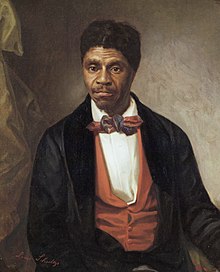
Dred Scott was built-in a slave in Virginia effectually 1799.[11] Little is known of his early years.[12] His owner, Peter Blow, moved to Alabama in 1818, taking his vi slaves along to work a farm nearly Huntsville. In 1830, Blow gave up farming and settled in St. Louis, Missouri, where he sold Scott to U.S. Army surgeon Dr. John Emerson.[13] Later purchasing Scott, Emerson took him to Fort Armstrong in Illinois. A free state, Illinois had been complimentary as a territory under the Northwest Ordinance of 1787, and had prohibited slavery in its constitution in 1819 when information technology was admitted as a state.
In 1836, Emerson moved with Scott from Illinois to Fort Snelling in the Wisconsin territory in what has become the state of Minnesota. Slavery in the Wisconsin Territory (some of which, including Fort Snelling, was part of the Louisiana Purchase) was prohibited by the U.S. Congress nether the Missouri Compromise. During his stay at Fort Snelling, Scott married Harriet Robinson in a civil ceremony by Harriet's owner, Major Lawrence Taliaferro, a justice of the peace who was also an Indian agent. The ceremony would take been unnecessary had Dred Scott been a slave, as slave marriages had no recognition in the police force.[14] [13]
In 1837, the army ordered Emerson to Jefferson Barracks War machine Post, south of St. Louis. Emerson left Scott and his wife at Fort Snelling, where he leased their services out for profit. By hiring Scott out in a free country, Emerson was finer bringing the institution of slavery into a free state, which was a direct violation of the Missouri Compromise, the Northwest Ordinance, and the Wisconsin Enabling Deed.[fourteen]
Irene Sanford Emerson [edit]
Before the end of the year, the regular army reassigned Emerson to Fort Jesup in Louisiana, where Emerson married Eliza Irene Sanford in February 1838. Emerson sent for Scott and Harriet, who proceeded to Louisiana to serve their master and his wife. Within months, Emerson was transferred back to Fort Snelling. While en route to Fort Snelling, Scott's girl Eliza was born on a steamboat underway on the Mississippi River between Illinois and what would get Iowa. Because Eliza was born in gratuitous territory, she was technically born as a free person under both federal and state laws. Upon inbound Louisiana, the Scotts could accept sued for their freedom, only did not. One scholar suggests that, in all likelihood, the Scotts would have been granted their liberty by a Louisiana court, as it had respected laws of free states that slaveholders forfeited their correct to slaves if they brought them in for extended periods. This had been the holding in Louisiana land courts for more than 20 years.[14]
Toward the end of 1838, the army reassigned Emerson back to Fort Snelling. By 1840, Emerson's wife Irene returned to St. Louis with their slaves, while Dr. Emerson served in the Seminole War. While in St. Louis, she hired them out. In 1842, Emerson left the army. Later he died in the Iowa Territory in 1843, his widow Irene inherited his manor, including the Scotts. For three years after John Emerson's death, she connected to lease out the Scotts as hired slaves. In 1846, Scott attempted to purchase his and his family'south freedom, but Irene Emerson refused, prompting Scott to resort to legal recourse.[fifteen]
Procedural history [edit]
Scott v. Emerson [edit]
Showtime country circuit court trial [edit]
Having been unsuccessful in his endeavor to purchase his liberty, Dred Scott, with the assist of his legal advisers, sued Emerson for his freedom in the Circuit Courtroom of St. Louis County on April 6, 1846.[16] : 36 A separate petition was filed for his married woman Harriet, making them the outset married couple to file freedom suits in tandem in their 50-year history.[17] : 232 They received financial assistance from the family of Dred's previous owner, Peter Blow.[14] Blow's girl Charlotte was married to Joseph Charless, an officeholder at the Bank of Missouri. Charless signed legal documents as security for the Scotts and later secured the services of the banking company's attorney, Samuel Mansfield Bay, for the trial.[13]
It was expected that the Scotts would win their freedom with relative ease.[fourteen] [17] : 241 By 1846, dozens of freedom suits had been won in Missouri past onetime slaves.[17] Most had claimed their legal right to liberty on the ground that they, or their mothers, had previously lived in gratis states or territories.[17] Among the most important legal precedents were Winny 5. Whitesides [18] and Rachel five. Walker. [xix] In Winny v. Whitesides, the Missouri Supreme Courtroom had ruled in 1824 that a person who had been held every bit a slave in Illinois, where slavery was illegal, and and so brought to Missouri, was gratuitous by virtue of residence in a free state.[16] : 41 In Rachel v. Walker, the state supreme courtroom had ruled that a U.S. Army officer who took a slave to a military post in a territory where slavery was prohibited and retained her there for several years, had thereby "forfeit[ed] his property".[16] : 42 Rachel, like Dred Scott, had accompanied her enslaver to Fort Snelling.[xvi]
Scott was represented past 3 different lawyers from the filing of the original petition to the time of the bodily trial, over one year later. The first was Francis B. Murdoch, a prolific freedom suit attorney who abruptly left St. Louis.[20] [xvi] : 38 Murdoch was replaced by Charles D. Drake, an in-law of the Blow family.[xvi] When Drake too left the country, Samuel M. Bay took over as the Scotts' lawyer.[16] Irene Emerson was represented by George W. Goode, a proslavery lawyer from Virginia.[21] : 130 By the time the instance went to trial, it had been reassigned from Judge John M. Krum, who was proslavery, to Judge Alexander Hamilton, who was known to exist sympathetic to liberty suits.[thirteen]
Dred Scott v. Irene Emerson finally went to trial for the first time on June 30, 1847.[21] : 130 Henry Peter Blow testified in court that his male parent had owned Dred and sold him to John Emerson.[16] : 44 The fact that Scott had been taken to live on costless soil was clearly established through depositions from witnesses who had known Scott and Dr. Emerson at Fort Armstrong and Fort Snelling.[21] : 130–131 Grocer Samuel Russell testified that he had hired the Scotts from Irene Emerson and paid her father, Alexander Sanford, for their services.[21] Upon cross test, however, Russell admitted that the leasing arrangements had actually been made by his wife, Adeline.[21]
Thus, Russell's testimony was ruled hearsay, and the jury returned a verdict for Emerson.[thirteen] This created a seemingly contradictory outcome in which Scott was ordered past the court to remain Irene Emerson'southward slave, because he had been unable to prove that he was previously Irene Emerson's slave.[thirteen]
First state supreme court appeal [edit]
Bay moved immediately for a new trial on the basis that Scott'southward case had been lost due to a technicality which could exist rectified, rather than the facts.[16] : 47 Judge Hamilton finally issued the order for a new trial on December 2, 1847.[16] Ii days subsequently, Emerson's lawyer objected to a new trial by filing a nib of exceptions.[16] [21] : 131 The case was and then taken on writ of error to the Supreme Court of Missouri.[13] Scott's new lawyers, Alexander P. Field and David North. Hall, argued that the writ of error was inappropriate because the lower court had non withal issued a last judgment.[16] : 50 The state supreme courtroom agreed unanimously with their position and dismissed Emerson'due south appeal on June 30, 1848.[16] The chief event before the court at this stage was procedural and no substantive problems were discussed.[16]
Second state excursion court trial [edit]
Before the state supreme court had convened, Goode had presented a motility on behalf of Emerson to accept Scott taken into custody and hired out.[21] On March 17, 1848, Guess Hamilton issued the order to the St. Louis County sheriff.[16] [b] Anyone hiring Scott had to mail service a bond of six-hundred dollars.[16] : 49 Wages he earned during that time were placed in escrow, to be paid to the party that prevailed in the lawsuit.[16] Scott would remain in the sheriff'south custody or hired out past him until March xviii, 1857.[sixteen] Ane of Scott'due south lawyers, David N. Hall, hired him starting March 17, 1849.[17] : 261
The St. Louis Burn of 1849, a cholera epidemic, and ii continuances delayed the retrial in the St. Louis Circuit Court until Jan 12, 1850.[thirteen] [16] : 51 Irene Emerson was at present defended past Hugh A. Garland and Lyman D. Norris, while Scott was represented by Field and Hall.[16] Judge Alexander Hamilton was presiding.[13] The proceedings were similar to the commencement trial.[16] : 52 The aforementioned depositions from Catherine A. Anderson and Miles H. Clark were used to plant that Dr. Emerson had taken Scott to free territory.[sixteen]
This time, the hearsay problem was surmounted by a deposition from Adeline Russell stating that she had hired the Scotts from Irene Emerson, thereby proving that Emerson claimed them as her slaves.[sixteen] Samuel Russell testified in courtroom one time again that he had paid for their services.[16] The defence force then changed strategy and argued in their summation that Mrs. Emerson had every correct to hire out Dred Scott, considering he had lived with Dr. Emerson at Fort Armstrong and Fort Snelling nether military jurisdiction, not under ceremonious law.[16] [21] : 132 In doing so, the defense ignored the precedent set past Rachel v. Walker. [21] In his rebuttal, Hall stated that the fact that they were military posts did not matter, and pointed out that Dr. Emerson had left Scott backside at Fort Snelling, hired out to others, after being reassigned to a new mail.[22]
The jury apace returned a verdict in favor of Dred Scott, nominally making him a gratis man.[21] [16] : 53 Judge Hamilton declared Harriet, Eliza and Lizzie Scott to be gratis as well.[16] Garland moved immediately for a new trial, and was overruled.[22] [16] : 55 On Feb xiii, 1850, Emerson's defense filed a bill of exceptions, which was certified by Judge Hamilton, setting into motion some other appeal to the Missouri Supreme Court.[16] Counsel for the opposing sides signed an understanding that moving forward, only Dred Scott v. Irene Emerson would be advanced, and that any conclusion made by the high court would apply to Harriet'southward suit, too.[16] : 43 In 1849 or 1850, Irene Emerson left St. Louis and moved to Springfield, Massachusetts.[16] : 55 Her brother, John F. A. Sanford, continued looking subsequently her business interests when she left,[23] and her departure had no bear on on the case.[16] : 56
Second land supreme court appeal [edit]
Both parties filed briefs with the Supreme Courtroom of Missouri on March 8, 1850.[16] : 57 A busy docket delayed consideration of the instance until the Oct term.[21] : 133 By then, the issue of slavery had go politically charged, even within the judiciary.[24] [21] : 134 Although the Missouri Supreme Court had non yet overturned precedent in freedom suits, in the 1840s, the court's proslavery justices had explicitly stated their opposition to freeing slaves.[24] Subsequently the court convened on Oct 25, 1850, the two justices who were proslavery anti-Benton Democrats – William Barclay Napton and James Harvey Birch – persuaded John Ferguson Ryland, a Benton Democrat, to bring together them in a unanimous conclusion that Dred Scott remained a slave under Missouri law.[21] [xvi] : 60 However, Judge Napton delayed writing the court's opinion for months.[21] Then in August 1851, both Napton and Birch lost their seats in the Missouri Supreme Court, following the state's outset supreme court election, with merely Ryland remaining as an incumbent.[21] The case thus needed to be considered again by the newly elected court.[21] : 135 The reorganized Missouri Supreme Courtroom now included two "moderates" – Hamilton Gamble and John Ryland – and 1 staunch proslavery justice, William Scott.[24]
David N. Hall had prepared the brief for Dred Scott, but died in March 1851.[sixteen] : 57, 61 Alexander P. Field continued alone equally counsel for Dred Scott, and resubmitted the same briefs from 1850 for both sides.[16] On November 29, 1851, the example was taken under consideration, on written briefs alone, and a determination was reached.[16] However, earlier Judge Scott could write the court'southward opinion, Lyman Norris, co-counsel for Irene Emerson, obtained permission to submit a new brief he had been preparing, to supercede the original 1 submitted by Garland.[16] : 56,61
Norris's brief has been characterized as "a sweeping denunciation of the say-so of both the [Northwest] Ordinance of 1787 and the Missouri Compromise."[xvi] : 62 Although he stopped short of questioning their constitutionality, Norris questioned their applicability and criticized the early on Missouri Supreme Court, ridiculing old Justice George Tompkins as "the bang-up apostle of freedom at that day."[24] [16] Reviewing the court's past decisions on freedom suits, Norris acknowledged that if Rachel v. Walker was immune to stand up, his client would lose.[24] Norris and then challenged the concept of "once free, ever free", and asserted that the court nether Tompkins had been wrong to rule that the Ordinance of 1787 remained in force subsequently the ratification of the U.Due south. Constitution in 1788.[24] Finally, he argued that the Missouri Compromise should exist disregarded whenever it interfered with Missouri constabulary, and that the laws of other states should non be enforced, if their enforcement would crusade Missouri citizens to lose their holding.[24] In support of his argument, he cited Main Justice Roger B. Taney's opinion in the The states Supreme Court case Strader 5. Graham, which argued that the condition of a slave returning from a free state must be determined past the slave state itself.[24] [16] : 63 According to historian Walter Ehrlich, the endmost of Norris's cursory was "a racist harangue that not only revealed the prejudices of its author, but too indicated how the Dred Scott example had go a vehicle for the expression of such views".[sixteen] : 63 Noting that Norris's proslavery "doctrines" were later incorporated into the courtroom's concluding determination,[16] : 62 Ehrlich writes (accent his):
From this indicate on, the Dred Scott case clearly changed from a genuine freedom adjust to the controversial political issue for which it became infamous in American history. [16]
On March 22, 1852, Gauge William Scott announced the conclusion of the Missouri Supreme Court that Dred Scott remained a slave, and ordered the trial court'due south judgment to be reversed.[21] : 137 Judge Ryland concurred, while Master Justice Hamilton Gamble dissented.[24] The majority opinion written by Judge Scott focused on the issue of comity or conflict of laws,[21] and relied on "states' rights" rhetoric:[16] : 65
Every State has the right of determining how far, in a spirit of comity, information technology will respect the laws of other States. Those laws have no intrinsic right to be enforced across the limits of the Land for which they were enacted. The respect allowed them will depend altogether on their conformity to the policy of our institutions. No State is jump to acquit into effect enactments conceived in a spirit hostile to that which pervades her own laws.[25]
Judge Scott did not deny the constitutionality of the Missouri Compromise, and acknowledged that its prohibition of slavery was "absolute", merely only within the specified territory.[xvi] Thus, a slave crossing the border could obtain his freedom, but only within the court of the gratuitous state.[16] Rejecting the courtroom's own precedent, Scott argued that "'In one case free' did not necessarily mean 'always free.'"[16] : 66 He cited the Kentucky Court of Appeals decision in Graham 5. Strader, which had held that a Kentucky slaveowner who permitted a slave to become to Ohio temporarily, did not forfeit ownership of the slave.[16] To justify overturning three decades of precedent, Estimate Scott argued that circumstances had changed:[21]
Times now are not every bit they were when the old decisions on this field of study were made. Since then not just individuals only States have been possessed with a dark and fell spirit in relation to slavery, whose gratification is sought in the pursuit of measures, whose inevitable upshot must be the overthrow and destruction of our regime. Under such circumstances it does non behoove the Country of Missouri to show the least eyebrow to whatever measure out which might gratify this spirit. She is willing to assume her total responsibility for the beingness of slavery inside her limits, nor does she seek to share or divide information technology with others.[25]
On March 23, 1852, the day afterwards the Missouri Supreme Court decision had been appear, Irene Emerson'due south lawyers filed an order in the St. Louis Circuit Court for the bonds signed by the Blow family to cover the Scotts' court costs; return of the slaves themselves; and transfer of their wages earned over four years, plus vi pct involvement.[13] On June 29, 1852, Guess Hamilton overruled the order.[16] : 70
Scott v. Sandford [edit]
The instance looked hopeless, and the Blow family could no longer pay for Scott's legal costs. Scott likewise lost both of his lawyers when Alexander Field moved to Louisiana and David Hall died. The case was undertaken pro bono by Roswell Field, who employed Scott as a janitor. Field likewise discussed the case with LaBeaume, who had taken over the lease on the Scotts in 1851.[26] After the Missouri Supreme Courtroom determination, Approximate Hamilton turned down a request by Emerson's lawyers to release the hire payments from escrow and to deliver the slaves into their owner's custody.[13]
In 1853, Dred Scott once more sued his current owner John Sanford, but this time in federal court. Sanford returned to New York and the federal courts had variety jurisdiction under Article III, Section two of the U.S. Constitution. In addition to the existing complaints, Scott alleged that Sanford had assaulted his family and held them captive for half dozen hours on January one, 1853.[27]
At trial in 1854, Judge Robert William Wells directed the jury to rely on Missouri police on the question of Scott'southward freedom. Since the Missouri Supreme Court had held that Scott remained a slave, the jury constitute in favor of Sanford. Scott then appealed to the U.South. Supreme Court, where the clerk misspelled the defendant's name, and the case was recorded every bit Dred Scott v. Sandford, with an always-erroneous title. Scott was represented before the Supreme Court past Montgomery Blair and George Ticknor Curtis, whose blood brother Benjamin was a Supreme Court Justice. Sanford was represented by Reverdy Johnson and Henry South. Geyer.[xiii]
Sandford equally defendant [edit]
When the case was filed, the two sides agreed on a statement of facts that claimed Scott had been sold by Dr. Emerson to John Sanford, though this was a legal fiction. Dr. Emerson had died in 1843, and Dred Scott had filed his 1847 suit against Irene Emerson. In that location is no tape of Dred Scott'southward transfer to Sanford or of his transfer dorsum to Irene. John Sanford died presently earlier Scott's manumission, and Scott was not listed in the probate records of Sanford's manor.[26] Also, Sanford was non acting equally Dr. Emerson'southward executor, every bit he was never appointed past a probate court, and the Emerson manor had been settled when the federal case was filed.[14]
The murky circumstances of ownership led many to conclude the parties to Dred Scott v. Sandford contrived to create a exam case.[xv] [26] [27] Mrs. Emerson'south remarriage to abolitionist U.S. Representative Calvin C. Chaffee seemed suspicious to contemporaries, and Sanford was idea to exist a front and to have allowed himself to be sued, despite not actually being Scott's owner. Nevertheless, Sanford had been involved in the case since 1847, earlier his sis married Chaffee. He had secured counsel for his sister in the state case, and he engaged the same lawyer for his own defense in the federal instance.[15] Sanford also consented to exist represented by genuine pro-slavery advocates before the Supreme Court, rather than to put upward a token defense.
Influence of President Buchanan [edit]
Historians discovered that after the Supreme Court heard arguments in the case just before it issued a ruling, President-elect James Buchanan wrote to his friend, Supreme Court Acquaintance Justice John Catron, to ask whether the case would exist decided past the Court before his inauguration in March 1857.[28] Buchanan hoped that the conclusion would quell unrest in the country over the slavery issue by issuing a ruling to take it out of political contend.
Buchanan later successfully pressured Associate Justice Robert Cooper Grier, a Northerner, to join the Southern majority in Dred Scott to prevent the advent that the decision was made along sectional lines.[29] Biographer Jean H. Baker articulates the view that Buchanan's utilize of political pressure on a member of a sitting court was regarded then, as now, to be highly improper.[xxx] Republicans fueled speculation equally to Buchanan's influence by publicizing that Taney had secretly informed Buchanan of the determination. Buchanan declared in his inaugural address that the slavery question would "be quickly and finally settled" by the Supreme Court.[31] [fourteen]
Supreme Courtroom conclusion [edit]
On March 6, 1857, the U.S. Supreme Courtroom ruled against Dred Scott in a 7–2 conclusion that fills over 200 pages in the United states of america Reports.[10] The determination contains opinions from all nine justices, but the "majority stance" has always been the focus of the controversy.[32]
Stance of the Court [edit]

7 justices formed the majority and joined an opinion written by main justice Roger Taney. Taney began with what he saw as the cadre upshot in the case: whether or non black people could possess federal citizenship under the U.S. Constitution.[ten]
The question is simply this: Can a negro, whose ancestors were imported into this country, and sold every bit slaves, go a member of the political community formed and brought into existence by the Constitution of the United States, and as such become entitled to all of the rights, and privileges, and immunities, guarantied [sic] past that instrument to the citizen?
— Dred Scott, threescore U.South. at 403.
In answer, the Court ruled that they could not. It held that black people could not exist American citizens, and therefore a lawsuit to which they were a party could never authorize for the "multifariousness of citizenship" that Commodity 3 of the Constitution requires for American federal courts to take jurisdiction over cases that do not involve federal questions.[10] The principal rationale for the Court'south ruling was Taney's exclamation that black African slaves and their descendants were never intended to be office of the American social and political landscape.[x]
We remember ... that [black people] are not included, and were non intended to be included, under the word "citizens" in the Constitution, and can therefore claim none of the rights and privileges which that instrument provides for and secures to citizens of the United States. On the contrary, they were at that time [of America's founding] considered equally a subordinate and junior class of beings who had been subjugated by the ascendant race, and, whether emancipated or non, yet remained subject to their authority, and had no rights or privileges but such equally those who held the power and the Regime might choose to grant them.
— Dred Scott, 60 U.S. at 404–05.[33]
Taney then extensively reviewed laws from the original American states that involved the condition of blackness Americans at the fourth dimension of the Constitution'south drafting in 1787.[10] He ended that these laws showed that a "perpetual and impassable bulwark was intended to be erected between the white race and the one which they had reduced to slavery".[34] Thus, he ended, black people were non American citizens, and could not sue as citizens in federal courts.[10] This meant that U.S. states lacked the power to change the legal status of blackness people past granting them country citizenship.[32]
It is hard at this 24-hour interval to realize the state of public stance in relation to that unfortunate race, which prevailed in the civilized and enlightened portions of the earth at the time of the Proclamation of Independence, and when the Constitution of the United States was framed and adopted. ... They had for more than a century before been regarded equally beings of an junior order ... and and so far inferior, that they had no rights which the white man was bound to respect; and that the negro might justly and lawfully exist reduced to slavery for his benefit.
— Dred Scott, 60 U.S. at 407.
This property commonly would have ended the decision, since information technology tending of Dred Scott'south case. But Taney did not conclude the matter earlier the Court in the normal manner.[ten] He went on to assess the constitutionality of the Missouri Compromise itself, writing that the Compromise's legal provisions intended to costless slaves who were living n of the 36°North latitude line in the western territories. Withal, in the Court'southward judgment, this would constitute the government depriving slaveowners of their property—since slaves were legally the property of their owners—without due process of law, which is forbidden under the 5th Amendment to the Constitution.[35] Taney also reasoned that the Constitution and the Bill of Rights implicitly precluded any possibility of ramble rights for black African slaves and their descendants.[32] Thus, Taney concluded:
Now, ... the right of holding in a slave is distinctly and expressly affirmed in the Constitution. ... Upon these considerations, information technology is the opinion of the court that the act of Congress which prohibited a denizen from holding and owning belongings of this kind in the territory of the U.s.a. n of the [36°N 36' breadth] line therein mentioned, is not warranted by the Constitution, and is therefore void.
— Dred Scott, sixty U.S. at 451–52.
Taney held that the Missouri Compromise was unconstitutional, marking the first fourth dimension since the 1803 case Marbury v. Madison that the Supreme Courtroom had struck downwards a federal law, though the Missouri Compromise had already been effectively overridden by the Kansas–Nebraska Human action. Taney made this statement on a narrow definition of the Property Clause of Section 3 of Article iv of the Constitution. The Property Clause states, "The Congress shall have Power to dispose of and make all needful Rules and Regulations respecting the Territory or other Property belonging to the United States..." Taney made the argument that the Property Clause "practical only to the property which us held in mutual at that time, and has no reference whatever to whatsoever territory or other property which the new sovereignty might afterwards itself learn."[36] Substantially, Taney asserted that because the Northwest Territory was non role of the U.s.a. at the time of the Constitution'south ratification, Congress did not have the dominance to ban slavery in the territory. Therefore according to Taney, the Missouri Compromise exceeded the scope of Congress's powers and was unconstitutional, and thus Dred Scott was yet a slave regardless of his fourth dimension spent in the parts of the Northwest Territory that were n of 36°N.[37] Therefore, he was nonetheless a slave under Missouri police force, and the Court had to follow Missouri constabulary in the matter. For all these reasons, the Court ended, Dred Scott could non bring conform in U.S. federal court.[37]
Dissents [edit]


Justices Benjamin Robbins Curtis and John McLean were the merely ii dissenters from the Court's decision, and both filed dissenting opinions.
Curtis's 67-page dissent argued that Taney's assertion that black people could not possess federal U.Due south. citizenship was historically and legally baseless.[32] Curtis pointed out that at the time of the Constitution'south adoption in 1789, blackness men could vote in five of the thirteen states. Legally, that made them citizens both of their individual states and of the United states of america federally. Curtis cited many land statutes and land court decisions supporting his position. His dissent was "extremely persuasive", and it prompted Taney to add 18 additional pages to his opinion in an attempt to rebut Curtis's arguments.[32]
McLean'south dissent deemed the argument that black people could not be citizens "more a matter of taste than of law". He attacked much of the Courtroom'due south decision equally obiter dicta that was not legally authoritative on the ground that once the court adamant that it did not have jurisdiction to hear Scott'due south case, it should have just dismissed the action, rather than passing judgment on the claim of the claims.
Curtis and McLean both attacked the Court's overturning of the Missouri Compromise on its merits. They noted that information technology was not necessary to determine the question and that none of the authors of the Constitution had ever objected on constitutional grounds to the Congress's adoption of the antislavery provisions of the Northwest Ordinance passed past the Continental Congress or the subsequent acts that barred slavery northward of 36°30' N, or the prohibition on importing slaves from overseas passed in 1808. Curtis said slavery was not listed in the constitution every bit a "natural right", simply rather a creation of municipal law. He pointed out the constitution said "The Congress shall have Power to dispose of and make all needful Rules and Regulations respecting the Territory or other Property belonging to the The states; and nothing in this Constitution shall be then construed as to Prejudice any Claims of the United states of america, or of any detail State." Since slavery was not mentioned every bit an exception, he felt a prohibition of it brutal within the scope of needed rules and regulations Congress was free to laissez passer.[38]
Reactions [edit]
The Supreme Court'due south decision in Dred Scott was "greeted with unmitigated wrath from every segment of the United States except the slave holding states."[32] The American political historian Robert G. McCloskey described:
The tempest of malediction that burst over the judges seems to have stunned them; far from extinguishing the slavery controversy, they had fanned its flames and had, moreover, deeply endangered the security of the judicial arm of government. No such vilification as this had been heard even in the wrathful days post-obit the Conflicting and Sedition Acts. Taney's stance was assailed past the Northern press every bit a wicked "stump speech" and was shamefully misquoted and distorted. "If the people obey this decision," said one newspaper, "they disobey God."[37]
Many Republicans, including Abraham Lincoln, who was rapidly becoming the leading Republican in Illinois, regarded the determination every bit part of a plot to expand and eventually impose the legalization of slavery throughout all of u.s.a..[39] Some southern extremists wanted all states to recognize slavery as a ramble right. Lincoln rejected the court's majority opinion that "the right of property in a slave is distinctly and expressly affirmed in the Constitution," pointing out that the constitution did not always mention property in reference to slaves and in fact explicitly referred to them as "persons".[xl] Southern Democrats considered Republicans to be lawless rebels who were provoking disunion by their refusal to have the Supreme Court'southward determination equally the law of the land. Many northern opponents of slavery offered a legal argument for refusing to recognize the Dred Scott conclusion on the Missouri Compromise every bit bounden. They argued that the Court'south conclusion that the federal courts had no jurisdiction to hear the case rendered the remainder of the conclusion obiter dictum—a non binding passing remark rather than an administrative interpretation of the law. Douglas attacked that position in the Lincoln-Douglas debates:
Mr. Lincoln goes for a warfare upon the Supreme Court of the United States, because of their judicial decision in the Dred Scott example. I yield obedience to the decisions in that court—to the final determination of the highest judicial tribunal known to our constitution.
In a spoken language at Springfield, Illinois, Lincoln responded that the Republican party was not seeking to defy the Supreme Court, just hoped they could convince it to reverse its ruling.[41]
We believe, as much as Guess Douglas, (maybe more) in obedience to, and respect for the judicial department of authorities. We recollect its decisions on Ramble questions, when fully settled, should command, not only the detail cases decided, but the general policy of the country, subject to be disturbed but by amendment of the Constitution equally provided in that musical instrument itself. More than than this would exist revolution. Just we think the Dred Scott decision is erroneous. We know the court that made it, has ofttimes over-ruled its own decisions, and we shall do what we can to take it to over-dominion this. We offer no resistance to information technology.
Democrats had refused to accept the court's interpretation of the U.Southward. Constitution equally permanently binding. During the Andrew Jackson administration, Taney, then Attorney Full general, had written:
Whatever may be the force of the conclusion of the Supreme Court in binding the parties and settling their rights in the particular example before them, I am not prepared to acknowledge that a construction given to the constitution past the Supreme Court in deciding any one or more cases fixes of itself irrevokably [sic] and permanently its construction in that detail and binds usa and the Legislative and executive branches of the General government, forever later on to accommodate to information technology and adopt it in every other case as the true reading of the instrument although all of them may unite in believing information technology erroneous.[42]
Frederick Douglass, a prominent black abolitionist who considered the determination to be unconstitutional and Taney'south reasoning reverse to the Founding Fathers' vision, predicted that political disharmonize could not be avoided:
The highest authority has spoken. The voice of the Supreme Courtroom has gone out over the troubled waves of the National Conscience.... [But] my hopes were never brighter than now. I have no fearfulness that the National Conscience will be put to slumber by such an open, glaring, and scandalous tissue of lies....[43]
According to Jefferson Davis, and so a U.South. Senator from Mississippi, and future President of the Confederate States of America, the case merely "presented the question whether Cuffee[44] should be kept in his normal condition or not . . . [and] whether the Congress of the United states could determine what might or might non be property in a Territory–the case existence that of an officeholder of the army sent into a Territory to perform his public duty, having taken with him his negro slave".[45]
Impact on both parties [edit]
Irene Emerson moved to Massachusetts in 1850 and married Calvin C. Chaffee, a dr. and abolitionist who was elected to Congress on the Know Nothing and Republican tickets. Post-obit the Supreme Courtroom ruling, pro-slavery newspapers attacked Chaffee as a hypocrite. Chaffee protested that Dred Scott belonged to his blood brother-in-constabulary and that he had nothing to practice with Scott'southward enslavement.[27] Nevertheless, the Chaffees executed a deed transferring the Scott family to Henry Taylor Blow, the son of Scott'south onetime owner, Peter Blow. Chaffee's lawyer suggested the transfer as the nigh user-friendly way of freeing Scott since Missouri law required manumitters to appear in person before the courtroom.[27]
Taylor Blow filed the manumission papers with Judge Hamilton on May 26, 1857. The emancipation of Dred Scott and his family was national news and was historic in northern cities. Scott worked every bit a porter in a hotel in St. Louis, where he was a minor celebrity. His wife took in laundry. Dred Scott died of tuberculosis on November 7, 1858. Harriet died on June 17, 1876.[thirteen]
Aftermath [edit]
Economic [edit]
Economist Charles Calomiris and historian Larry Schweikart discovered that doubt nearly whether the entire West would suddenly become slave territory or engulfed in combat like "Bleeding Kansas" gripped the markets immediately. The east–w railroads complanate immediately (although north–south lines were unaffected), causing, in plow, the nearly-collapse of several large banks and the runs that ensued. What followed the runs has been chosen the Panic of 1857.
The Panic of 1857, unlike the Panic of 1837, virtually exclusively impacted the North, a fact that Calomiris and Schweikart attribute to the Due south's system of branch banking, as opposed to the North's system of unit banking. In the S's co-operative banking system, information moved reliably amongst the branch banks and transmission of the panic was modest. Northern unit banks, in contrast, were competitors and seldom shared such vital data.[46]
Political [edit]
Southerners, who had grown uncomfortable with the Kansas-Nebraska Act, argued that they had a constitutional right to bring slaves into the territories, regardless of any conclusion by a territorial legislature on the subject area. The Dred Scott decision seemed to endorse that view.
Although Taney believed that the decision represented a compromise that would be a final settlement of the slavery question by transforming a contested political issue into a matter of settled constabulary, the decision produced the opposite result. It strengthened Northern opposition to slavery, divided the Democratic Party on exclusive lines, encouraged secessionist elements among Southern supporters of slavery to make bolder demands, and strengthened the Republican Party.
Afterwards references [edit]
In 1859, when defending John Anthony Copeland and Shields Green from the accuse of treason, following their participation in John Brown's raid on Harpers Ferry, their attorney, George Sennott, cited the Dred Scott decision in arguing successfully that since they were non citizens according to that Supreme Courtroom ruling, they could not commit treason.[47] The charge of treason was dropped, just they were found guilty and executed on other charges.
Justice John Marshall Harlan was the lonely dissenting vote in Plessy v. Ferguson (1896), which declared racial segregation constitutional and created the concept of "carve up simply equal". In his dissent, Harlan wrote that the majority'due south opinion would "prove to be quite as pernicious equally the decision made by this tribunal in the Dred Scott case".[48]
Charles Evans Hughes, writing in 1927 on the Supreme Court's history, described Dred Scott 5. Sandford as a "self-inflicted wound" from which the court would not recover for many years.[49] [50] [51]
In a memo to Justice Robert H. Jackson in 1952, for whom he was clerking, on the bailiwick of Brown 5. Board of Pedagogy, the future Chief Justice William H. Rehnquist wrote that "Scott v. Sandford was the outcome of Taney's effort to protect slaveholders from legislative interference."[52]
Justice Antonin Scalia made the comparison between Planned Parenthood v. Casey (1992) and Dred Scott in an endeavor to run into Roe v. Wade overturned:
Dred Scott ... rested upon the concept of "substantive due process" that the Court praises and employs today. Indeed, Dred Scott was very maybe the first application of substantive due procedure in the Supreme Court, the original precedent for... Roe v. Wade.[53]
Scalia noted that the Dred Scott determination had been written and championed past Taney and left the justice'due south reputation irrevocably tarnished. Taney, who was attempting to end the disruptive question of the future of slavery, wrote a decision that "inflamed the national debate over slavery and deepened the divide that led ultimately to the Civil State of war".[54]
Principal Justice John Roberts compared Obergefell v. Hodges (2015) to Dred Scott, as another instance of trying to settle a contentious issue through a ruling that went across the scope of the Constitution.[55]
Legacy [edit]
- 1977: The Scotts' great-grandson, John A. Madison, Jr., an attorney, gave the invocation at the ceremony at the Old Courthouse in St. Louis, a National Historic Landmark, for the dedication of a National Historic Marker commemorating the Scotts' case tried in that location.[56]
- 2000: Harriet and Dred Scott'southward petition papers in their freedom suit were displayed at the main co-operative of the St. Louis Public Library, following the discovery of more than 300 freedom suits in the archives of the U.S. circuit court.[57]
- 2006: A new celebrated plaque was erected at the Old Courthouse to honor the agile roles of both Dred and Harriet Scott in their freedom conform and the case's significance in U.S. history.[58]
- 2012: A monument depicting Dred and Harriet Scott was erected at the Old Courthouse's east archway facing the St. Louis Gateway Arch.[59]
See as well [edit]
- Anticanon
- American slave court cases
- Liberty suit
- Origins of the American Civil War
- Privileges and Immunities Clause
- Timeline of the civil rights movement
Notes [edit]
- ^ John Sandford's surname was actually "Sanford". A Supreme Courtroom clerk of court misspelled his name in 1856 and the error was never corrected.[2]
- ^ Legal historian Walter Ehrlich implies that the custody order practical just to Dred Scott, while Don Fehrenbacher suggests that information technology applied to both Dred and Harriet.
References [edit]
Citations [edit]
- ^ Daniel A. Farber, A Fatal Loss of Residue: Dred Scott Revisited, UC Berkeley Public Police force Research Paper No. 1782963 (2011).
- ^ Vishneski (1988), p. 373, notation 1.
- ^ a b Chemerinsky (2015), p. 722. sfnp error: no target: CITEREFChemerinsky2015 (assist)
- ^ a b Nowak & Rotunda (2012), §18.half dozen.
- ^ Staff (October 14, 2015). "13 Worst Supreme Court Decisions of All Time". FindLaw . Retrieved June 10, 2021.
- ^ Bernard Schwartz (1997). A Volume of Legal Lists: The Best and Worst in American Law . Oxford University Press. p. 70.
- ^ Junius P. Rodriguez (2007). Slavery in the United States: A Social, Political, and Historical Encyclopedia. ABC-CLIO. p. 1. ISBN9781851095445.
- ^ David Konig; et al. (2010). The Dred Scott Case: Historical and Gimmicky Perspectives on Race and Law. Ohio University Press. p. 213. ISBN9780821419120.
- ^ Chemerinsky (2015), p. 723. sfnp error: no target: CITEREFChemerinsky2015 (help)
- ^ a b c d eastward f g h i j Chemerinsky (2019), § 9.3.i, p. 750.
- ^ Melvin I. Urofsky, Dred Scott at the Encyclopædia Britannica
- ^ Earl M. Maltz, Dred Scott and the Politics of Slavery (2007)
- ^ a b c d e f 1000 h i j k l m "Missouri'southward Dred Scott Case, 1846–1857". Missouri Digital Heritage: African American History Initiative . Retrieved July xv, 2015.
- ^ a b c d due east f g Finkelman (2007).
- ^ a b c Don E. Fehrenbacher, The Dred Scott Case: Its Significance in American Constabulary and Politics (2001)
- ^ a b c d eastward f one thousand h i j k l thou n o p q r southward t u 5 w x y z aa ab ac ad ae af ag ah ai aj ak al am an ao ap aq ar as at au av aw ax Ehrlich, Walter (2007). They Accept No Rights: Dred Scott's Struggle for Freedom. Applewood Books.
- ^ a b c d eastward VanderVelde, Lea (2009). Mrs. Dred Scott: A Life on Slavery's Borderland. Oxford University Press. ISBN9780195366563.
- ^ i Mo. 472, 475 (Mo. 1824).
- ^ 4 Mo. 350 (Mo. 1836).
- ^ Gardner, Eric (Spring 2007). "'You Have No Business to Whip Me': The Liberty Suits of Polly Wash and Lucy Ann Delaney". African American Review. 41 (1): 40, 47. JSTOR 40033764.
- ^ a b c d eastward f yard h i j k fifty yard north o p q r due south Fehrenbacher, Don Edward (1981). Slavery, Law and Politics: The Dred Scott Case in Historical Perspective. New York: Oxford University Press. ISBN0-xix-502882-1.
- ^ a b Lawson, John, ed. (1921). American State Trials. Vol. 13. St. Louis: Thomas Police force Book Company. pp. 237–238.
- ^ Finkelman, Paul (December 2006). "Scott five. Sandford: The Courtroom'due south Virtually Dreadful Case and How It Changed History". Chicago-Kent Law Review. 82 (1): 25 – via Scholarly Eatables @ IIT Chicago-Kent College of Law.
- ^ a b c d e f g h i Boman, Dennis K. (2000). "The Dred Scott Case Reconsidered: The Legal and Political Context in Missouri". American Periodical of Legal History. 44 (four): 421, 423–424, 426. JSTOR 3113785.
- ^ a b "Scott five. Emerson, xv Mo. 576 (1852)". Caselaw Access Project, Harvard Law Schoolhouse . Retrieved April 1, 2022.
- ^ a b c Ehrlich, Walter (September 1968). "Was the Dred Scott Case Valid?". The Periodical of American History. Organization of American Historians. 55 (two): 256–265. doi:10.2307/1899556. JSTOR 1899556.
- ^ a b c d Hardy, David T. (2012). "Dred Scott, John San(d)ford, and the Case for Collusion" (PDF). Northern Kentucky Law Review. 41 (1). Archived from the original (PDF) on October x, 2015.
- ^ Maltz, Earl M. (2007). Dred Scott and the politics of slavery. Lawrence: University Press of Kansas. p. 115. ISBN978-0-7006-1502-5.
- ^ Faragher, John Mack; et al. (2005). Out of Many: A History of the American People (Revised Printing (fourth Ed) ed.). Englewood Cliffs, N.J: Prentice Hall. p. 388. ISBN0-thirteen-195130-0.
- ^ Baker, Jean H. (2004). James Buchanan: The American Presidents Series: The 15th President, 1857–1861. Macmillan. ISBN978-0-8050-6946-four.
- ^ "James Buchanan: Inaugural Accost. U.South. Inaugural Addresses. 1989". Bartleby.com. Retrieved July 26, 2012.
- ^ a b c d e f Nowak & Rotunda (2012), § xviii.6.
- ^ Quoted in part in Chemerinsky (2019), § 9.3.1, p. 750.
- ^ Chemerinsky (2019), § nine.3.i, p. 750, quoting Dred Scott, 60 U.S. at 409.
- ^ Chemerinsky (2019), § 9.three.ane, pp. 750–51.
- ^ ( Dred Scott five. Sanford , 60 U.Due south. 149.)
- ^ a b c McCloskey (2010), p. 62.
- ^ "Dred Scott 5. Sanford (1857) Excerpts From Majority and Dissenting Opinions". Neb of Rights Institute.
- ^ "Digital History". world wide web.digitalhistory.uh.edu . Retrieved June 12, 2019.
- ^ "Abraham Lincoln's Cooper Wedlock Address". world wide web.abrahamlincolnonline.org.
- ^ http://www.mrlincolnandfreedom.org/pre-ceremonious-state of war/dred-scott/voice communication-at-springfield-june-26-1857/
- ^ Don E. Fehrenbacher (1978/2001), The Dred Scott Case: Its Significance in American Constabulary and Politics, reprint, New York: Oxford, Part 3, "Consequences and Echoes", Chapter 18, "The Judges Judged", p. 441; unpublished opinion, transcript in Carl B. Swisher Papers, Manuscript Partitioning, Library of Congress.
- ^ Finkleman, Paul (March 15, 1997). Dred Scott vs. Sandford: A Cursory History with Documents – Google Boeken. ISBN9780312128074.
- ^ a derogatory term for a black person
- ^ Accost to the United States Senate on May 7, 1860, reprinted as Appendix F to Davis, Rise and Autumn of the Confederate Government (1880).
- ^ Charles Calomiris and Larry Schweikart, "The Panic of 1857: Origins, Transmission, Containment", Journal of Economical History, LI, December 1990, pp. 807–34.
- ^ Lubet, Steven (June 1, 2013). "Execution in Virginia, 1859: The Trials of Green and Copeland". Due north Carolina Police force Review. 91 (5).
- ^ Fehrenbacher, p. 580.
- ^ Hughes, Charles Evans (1936) [1928]. The Supreme Courtroom of the United States. Columbia University Printing. pp. 50–51. ISBN978-0-231-08567-0.
- ^ "Introduction to the court stance on the Dred Scott case". U.Due south. Section of Land. Retrieved July 16, 2015.
- ^ "Remarks of the Chief Justice". Supreme Court of the United States. March 21, 2003. Retrieved November 22, 2007.
- ^ Rehnquist, William. "A Random Thought on the Segregation Cases" Archived 2008-09-21 at the Wayback Car.
- ^ Planned Parenthood of Southeastern Pa. v. Casey, 505 U.Southward. 833 (1992). FindLaw.
- ^ Carey, Patrick W. (April 2002). "Political Atheism: Dred Scott, Roger Brooke Taney, and Orestes A. Brownson". The Catholic Historical Review. The Catholic University of America Press. 88 (2): 207–229. doi:x.1353/cat.2002.0072. ISSN 1534-0708. S2CID 153950640.
- ^ Obergefell v. Hodges, 576 U.S. (1992).
- ^ Arenson, Adam (2010), "Dred Scott versus the Dred Scott Case", The Dred Scott Case: Historical and Contemporary Perspectives on Race and Law, Ohio University Press, p. 36, ISBN978-0821419120
- ^ Arenson (2010), p. 38
- ^ Arenson (2010), p. 39
- ^ Patrick, Robert (August 18, 2015). "St. Louis judges want sculpture to honor slaves who sought freedom here". stltoday.com . Retrieved September 2, 2018.
Attendees get their first await after the unveiling of the new Dred and Harriet Scott statue on the grounds of the Old Courthouse in downtown St. Louis on Friday, June 8, 2012.
Works cited [edit]
- Arenson, Adam (2010). "Dred Scott Versus the Dred Scott Instance". In Konig, David Thomas; Finkelman, Paul; Bracey, Christopher Alan (eds.). The Dred Scott Case: Historical and Contemporary Perspectives on Race and Law. Columbus, OH: Ohio State University Printing. ISBN978-0821419120.
- Chemerinsky, Erwin (2019). Ramble Police: Principles and Policies (sixth ed.). New York: Wolters Kluwer. ISBN978-1-4548-9574-9.
- Ehrlich, Walter (1968). "Was the Dred Scott Example Valid?". The Journal of American History. 55 (2): 256–265. doi:10.2307/1899556. JSTOR 1899556.
- Finkelman, Paul (2007). "Scott 5. Sandford: The Courtroom's Most Dreadful Case and How it Inverse History" (PDF). Chicago-Kent Law Review. 82 (iii): 3–48.
- Hughes, Charles Evans (1936) [1928]. The Supreme Court of the United States. Columbia University Press. ISBN978-0-231-08567-0.
- McCloskey, Robert Grand. (2010). The American Supreme Courtroom. Revised by Sanford Levinson (5th ed.). Chicago: University of Chicago Press. ISBN978-0-226-55686-iv.
- Nowak, John E.; Rotunda, Ronald D. (2012). Treatise on Ramble Police force: Substance and Procedure (fifth ed.). Eagan, MN: W Thomson/Reuters. OCLC 798148265.
- Vishneski, John South. (1988). "What the Court Decided in Dred Scott v. Sandford". American Periodical of Legal History. 32 (iv): 373–390. doi:10.2307/845743. JSTOR 845743.
Further reading [edit]
- Dennis-Jonathan Mann & Kai Purnhagen: The Nature of Union Citizenship between Autonomy and Dependency on (Fellow member) Land Citizenship – A Comparative Analysis of the Rottmann Ruling, or: How to Avoid a European Dred Scott Decision?, in: 29:3 Wisconsin International Law Periodical (WILJ), (Fall 2011), pp. 484–533 (PDF).
- Fehenbacher, Don East., The Dred Scott Case: Its Significance in American Police force and Politics New York: Oxford (1978) [winner of Pulitzer Prize for History].
- Fehrenbacher, Don E. Slavery, Police, and Politics: The Dred Scott Case in Historical Perspective (1981) [abridged version of The Dred Scott Case].
- Konig, David Thomas, Paul Finkelman, and Christopher Alan Bracey, eds. The "Dred Scott" Case: Historical and Contemporary Perspectives on Race and Law (Ohio University Printing; 2010) 272 pages; essays by scholars on the history of the case and its afterlife in American law and society.
- Potter, David Thou. The Impending Crisis, 1848–1861 (1976) pp 267–96.
- VanderVelde, Lea. Mrs. Dred Scott: A Life on Slavery'southward Frontier (Oxford University Printing, 2009) 480 pp.
- Swain, Gwenyth (2004). Dred and Harriet Scott: A Family unit'southward Struggle for Liberty. Saint Paul, MN: Borealis Books. ISBN978-0-87351-482-eight.
- Tushnet, Mark (2008). I Dissent: Great Opposing Opinions in Landmark Supreme Court Cases. Boston: Beacon Press. pp. 31–44. ISBN978-0-8070-0036-6.
- Listen to: American Pendulum Ii – 🔊 Heed Now: American Pendulum Two
External links [edit]
-
 Texts on Wikisource:
 - Dred Scott five. Sandford
- "Dred Scott Case". New International Encyclopedia. 1905.
- "Dred Scott Case". Collier'due south New Encyclopedia. 1921.
- Text of Dred Scott v. Sandford, 60 U.S. (19 How.) 393 (1857) is available from:Cornell Findlaw Justia Library of Congress OpenJurist Oyez (oral argument sound)
- The Dred Scott decision. Opinion of Principal Justice Taney, with an introduction by Dr. J. H. Van Evrie. Likewise, an appendix, containing an essay on the natural history of the prognathous race of mankind, originally written for the New York Day-book, by Dr. South. A. Cartwright, of New Orleans. New York: Van Evrie, Horton & Co. 1863.
- Primary documents and bibliography about the Dred Scott case, from the Library of Congress
- "Dred Scott determination", Encyclopædia Britannica 2006. Encyclopædia Britannica Online. 17 Dec 2006. www.yowebsite.com
- Gregory J. Wallance, "Dred Scott Decision: The Lawsuit That Started The Ceremonious State of war", History.net, originally in Ceremonious War Times Magazine, March/Apr 2006
- Jefferson National Expansion Memorial, National Park Service
- Infography about the Dred Scott Case
- The Dred Scott Case Collection, Washington University in St. Louis
- Study of the Brown University Steering Committee on Slavery and Justice
- Dred Scott example articles from William Lloyd Garrison's abolitionist newspaper The Liberator
- "Supreme Courtroom Landmark Instance Dred Scott v. Sandford" from C-SPAN'southward Landmark Cases: Historic Supreme Court Decisions
- Study of the Decision of the Supreme Court of the United states and the Opinions of the Judges Thereof, in the Case of Dred Scott Versus John F.A. Sandford. Dec Term, 1856 via Google Books
Source: https://en.wikipedia.org/wiki/Dred_Scott_v._Sandford
0 Response to "What Law Was Found to Be Unconstitutional in the Dred Scott Decision?"
Post a Comment